Somewhere on a reel or cassette recorded in Russell County in 1978, Genevieve Wilson begins to tell a ghost story.
We know the date: November 28. We know the interviewer: Robin Roy West. We know the catalog numbers assigned to the two halves of the conversation: 1976OH104.37a and 1976OH104.37b. A public description says Wilson recalled a bewitching story, a ghost story passed through her family, and a dream she connected to her grandfather’s death.
We also know what those facts do not establish.
They do not prove that anyone was bewitched. They do not make a warning dream prophetic. They do not tell us how Wilson sounded when she reached the part she found most important, what question led her there, or what silence followed.
For that, you need the recording.
Kentucky began collecting voices like Wilson’s during the American bicentennial era. County libraries received recording equipment and an assignment both simple and enormous: ask local people to remember. The resulting interviews preserved work, war, schools, farms, politics, music, family life—and stories about the dead.
The ghosts are only part of what survived on the tape.
A statewide project built county by county
The Kentucky Oral History Commission was founded in 1976. Its early county-library initiative attempted something unusual: create a historical record not only from governors, generals, business leaders, and published authors, but from people whose lives might otherwise leave few pages in an archive.
Libraries across the Commonwealth received equipment and support. Local interviewers sat with neighbors, relatives, teachers, farmers, workers, veterans, musicians, and community elders. The interviews were cataloged by county and project. Together they became a map of Kentucky made from conversation.
The map was never perfectly even.
Some counties recorded more than others. Interviewers brought different skills and interests. Narrators came through family and community networks rather than a scientific sample. Equipment varied. Release paperwork was sometimes complete and sometimes missing. Certain voices were invited more often; others remained outside the room.
That means the collection cannot be treated as a referendum on what “Kentuckians believed.” It records what particular people chose to tell particular interviewers on particular days.
That limitation is also its strength. Oral history preserves the encounter itself.
Genevieve Wilson’s catalog trail
Wilson’s interview belongs to the Russell County Oral History Project. The public catalog describes both halves in the same broad terms: a bewitching account, a ghost story credited to her grandmother or family tradition, a dream premonition associated with her grandfather’s death, Civil War family folklore, and discussion of teaching art.
That last subject matters.
If a website extracts only the ghost, it turns a person into a delivery mechanism for spooky content. The full description reminds us that Wilson was discussing a life. Supernatural tradition sat beside family history and work. The interview was not necessarily a “paranormal investigation.” It was a conversation in which belief, memory, and biography overlapped.
The catalog says a release form is available. It does not provide a publishable transcript. That is why this article does not reproduce her words or embed the archival audio. Readers who want to hear the recordings should follow the repository’s access process and listen to the complete interview, not a rewritten imitation.
What can we learn before hearing it?
We can learn how the record was made. We can trace the project, narrator, interviewer, date, subjects, and catalog history. We can compare Wilson’s themes with broader Kentucky folklore scholarship. And we can identify the questions a responsible listener should bring to the tape.
What a ghost story proves
When a narrator says she saw a light move through a cemetery, heard a dead relative call her name, or dreamed of a death before it happened, the recording proves first that she told that account.
That may sound like a small claim. It is not.
A story can reveal which details a teller considered persuasive. It can show how belief was negotiated: “I do not believe in ghosts, but…” is one of folklore’s most useful openings. It can document who was allowed to tell frightening stories, which relatives were presented as trustworthy, and where the boundaries between religion, superstition, intuition, and entertainment were drawn.
The recording also preserves performance. Pace, laughter, hesitation, lowered volume, repetition, and an interviewer’s response can change the meaning of the words. A transcript is searchable and accessible, but it flattens the voice. A clipped quotation flattens it further.
None of this proves the supernatural event occurred as remembered. Oral testimony is evidence of experience and recollection, not a magical exception to ordinary verification.
If a narrator names a death, storm, fire, church, mine, or military unit, documents may test those details. If a story was allegedly told for generations, earlier publications or independent recordings may help trace it. But a documentable death does not document an apparition, and two similar stories do not automatically confirm each other. They may share a common source.
Warning dreams and the work of grief
The catalog’s reference to Wilson’s dream belongs to a large family of narratives sometimes called death warnings or crisis apparitions. A dream, sound, animal, broken object, sudden light, or unexplained feeling appears before news of a death.
Such accounts do more than frighten. They give sequence to loss.
Death often arrives without narrative preparation. A warning story moves a sign before the event. What felt meaningless at the time becomes charged in memory. The teller may wonder why the message was missed, whether anything could have changed, or whether the dream meant that a relationship continued beyond distance.
Folklorists do not need to decide whether the warning came from outside the mind to study what the story does. It can express guilt, comfort, family closeness, religious expectation, or the conviction that death announces itself.
The timing still matters. Was the dream written down before the death, or remembered afterward? How much time passed before the interview? Did relatives repeat the story until one version became standard? Those questions do not insult the narrator. They locate the claim.
Bewitching is not one simple category
“Bewitching” in a catalog description can point toward very different traditions: unexplained illness, livestock trouble, household disturbances, harmful envy, folk healing, religious conflict, or a story told mainly for suspense.
It should never be expanded casually into claims about Satanism, Indigenous practice, or a single statewide system of “mountain magic.” Those are internet shortcuts, not historical interpretation.
Context begins with the narrator’s own terms. Who was believed to possess power? What action caused suspicion? Was the accused named or anonymized? Did the story end in punishment, healing, reconciliation, or uncertainty? Was it told as something the narrator believed, something an older relative believed, or simply something worth remembering?
Kentucky folklore developed across African American, Indigenous, European American, immigrant, religious, occupational, and regional traditions. Similar motifs can travel between communities without having the same meaning in each. A responsible article resists turning all unusual belief into one exotic Appalachian category.
The child in the room
A public description of the Wilson excerpts notes that a young girl’s voice can be heard during the recording. Her identity is uncertain.
That small detail changes the scene.
The interview was not produced in an acoustically sealed studio. Family or community life continued around the recorder. A child may have listened while an older woman told stories received from an earlier generation. If so, transmission was not merely the subject of the interview. It was happening in the room.
The unidentified voice also raises a privacy question. Being audible on an old recording is not the same as knowingly becoming part of a modern web feature. Ethical reuse must consider everyone captured by the microphone, not only the named narrator.
This article therefore treats the child’s presence as a cataloged uncertainty and goes no further.
Kentucky’s other ghost archives
The County Collection is not the Commonwealth’s only reservoir of supernatural tradition.
Western Kentucky University’s Folklife Archives hold thousands of sound recordings and manuscript collections. The Lynwood Montell Collection includes interviews about ghosts, occupations, remedies, religion, and community life, along with drafts behind Montell’s many books. WKU also catalogs a dedicated Ghost Stories collection as FA 819.
Montell’s work demonstrates why place alone is not the story. His collections move through coal camps, river communities, farms, roads, battlefields, funeral homes, and family houses. The recurring subject is not simply whether a specter appeared. It is how Kentuckians used encounters with the dead to discuss violence, obligation, unfinished business, kinship, and the moral character of a place.
Other archives at the University of Kentucky, University of Louisville, regional universities, county libraries, and local historical organizations preserve interviews that may contain folklore even when “ghost” never appears in the title. A mining interview may include a warning voice underground. A church history may preserve a death omen. A midwifery interview may move between medicine, prayer, and belief.
Discovery depends on reading beyond the obvious keyword.
How to listen to an old ghost story
Approach an archival recording with two kinds of attention.
First, listen for the tale. What happened? Where does suspense begin? Which image remains after the ending? Does the narrator invite belief, challenge disbelief, or leave the event unresolved?
Then listen for the record around it:
- Who asks the questions?
- How does the narrator know the story?
- Is it firsthand, inherited, or repeated from community talk?
- What date is the event assigned, if any?
- What other subjects surround it in the full interview?
- Who else can be heard?
- What has an editor removed from the excerpt?
- What restrictions or release terms govern reuse?
Those questions do not drain the darkness from a story. They reveal its shape.
Why the voices should not be replaced
Modern technology makes it easy to “restore” a weak recording until a person sounds unnaturally close. It makes it easier still to generate a clean voice reading a transcript.
That would defeat the purpose.
Tape hiss, room noise, pauses, and microphone distance are part of the historical artifact. Careful preservation can improve audibility without inventing speech. A human-checked transcript can open the interview to Deaf and hard-of-hearing readers. Neither should manufacture certainty where the tape is unclear.
An actor or synthetic narrator may be useful in openly labeled fiction. It is not the archival voice. Dark Kentucky will not present reenactment or AI speech as a substitute for a narrator whose recording survives.
The video below is a long institutional tutorial about finding Kentucky archival materials online. It is included for research context only; it does not contain or replace Wilson’s ghost accounts.
The history hiding inside the haunting
Ghost-story pages usually lead with locations: a bridge, a house, a cemetery, a road. The county recordings point in another direction.
They lead to people.
A ghost account can preserve the name of the person who told it, the relative who told it first, the interviewer who thought it worth recording, and the library project that kept the tape. It can reveal funeral practices, family authority, religious language, ideas about dreams, and the ordinary sound of a Kentucky room in the 1970s.
That is already a remarkable historical record. No apparition is required.
Genevieve Wilson’s catalog entry leaves us at the archive door. Behind it is a full conversation that deserves to be heard on its own terms, with its provenance and permissions intact. Until then, the honest story is not a transcript we do not possess. It is how Kentucky decided that voices like hers belonged in history.
The tape does not tell us whether the dead returned.
It tells us that the living kept talking about them—and that someone pressed Record.
Tell the story. Find the history. Follow the evidence. Let the reader decide.
Sources and further research
- Pass the Word: Kentucky oral-history discovery portal
- 2024 Kentucky Oral History Public Catalog
- WKU Special Collections and Folklife Archives
- WKU Folklife Archives Finding Aids, including Ghost Stories FA 819
- Kentucky Folklife Program oral-history projects
- University Press of Kentucky: Tales of Kentucky Ghosts
- Smithsonian Folklife and Oral History Interviewing Guide
- Oral History Association: Oral History Defined
Rights note: This article does not reproduce archival audio, unpublished transcript text, or repository photography. Catalog descriptions are used to identify and contextualize records. Readers should consult the holding repository for access and reuse terms.
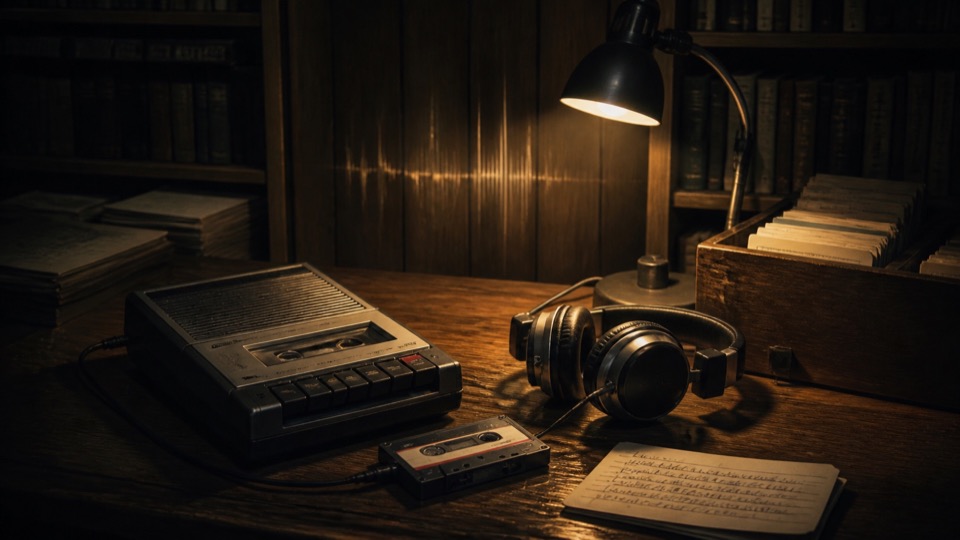
Featured-image note: The lead image is an AI-generated editorial still life of 1970s recording equipment. It does not depict a specific archive or interview.