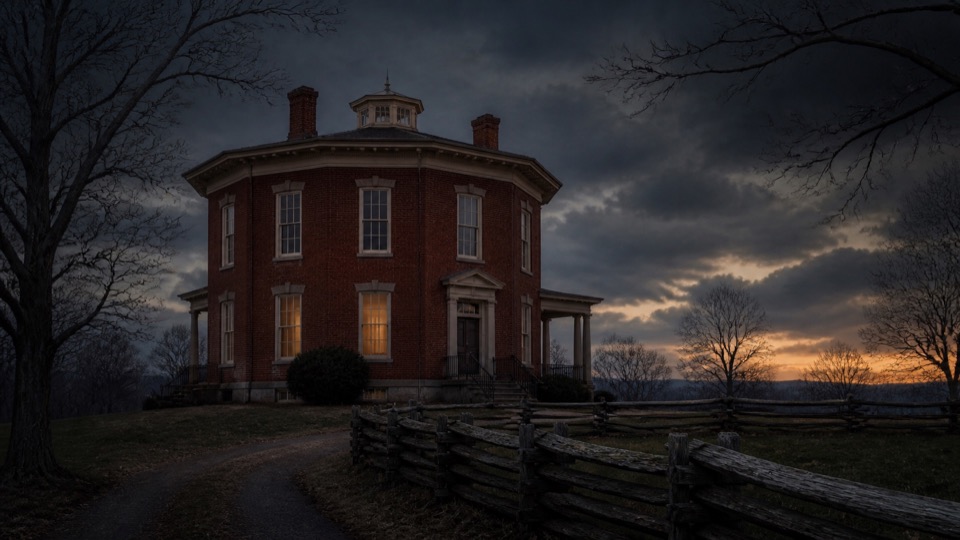
North of Franklin, Kentucky, an old brick house refuses to present a proper front.
Approach it from one direction and three walls seem to face you at once. Walk around it and the angles keep changing. Windows catch light from several directions. Rooms connect through a plan designed to move air through the building. Above the two main stories, a cupola once completed the geometry.
Octagon Hall was meant to be noticed.
The house has since become known for something its builder could not have planned: a reputation as one of Kentucky’s most haunted places. Visitors hear about Confederate soldiers concealed in hidden spaces, wounded men treated in a wartime hospital, graves on the grounds, a secret tunnel, and children whose deaths supposedly left them inside the house. Television crews and paranormal investigators have added voices, shadows, cold spots, and named spirits.
Some of that history has a record behind it. Some survives as tradition. Some appears only in modern retellings. And one of the best-known ghost stories conflicts with a federal census.
Octagon Hall is most revealing when those layers are not blended together. It is an unusual house created within slavery, a Confederate household beside an army’s retreat route, and a preservation site whose haunted identity developed much later.
The building does not need every story told about it to be true. Its documented history is dark enough.
The house Andrew Caldwell wanted noticed
Andrew Jackson Caldwell began planning or building his octagonal residence in the late 1840s. Sources differ over whether work started in 1847 or 1848 and whether the house was completed in 1859, 1860, or closer to the Civil War. The surviving evidence nevertheless places its long construction campaign in the two decades before the war.
Octagonal houses were then enjoying a brief American fashion. In 1848, Orson Squire Fowler published The Octagon House: A Home for All, arguing that an eight-sided plan enclosed more useful space, improved ventilation, admitted more light, and reduced construction costs. Octagon Hall shares several ideas associated with that movement, although no recovered Caldwell document proves that Fowler’s book supplied the design.
The result is a two-story brick house set over a high basement. Its central hall serves four principal rooms on each main floor. Numerous windows and interior openings help circulate air. Three prominent faces reportedly use Flemish-bond brickwork, while the remaining walls use common bond. A detached brick summer kitchen also survives as part of the historic complex.
Its materials were said to have come largely from the property: limestone for the foundation, clay for bricks, and timber for the frame and finish. That description can make the house sound like the solitary achievement of an inventive landowner.
It was not.
The people reduced to numbers
Andrew Caldwell enslaved people.
The 1850 federal slave schedule records 10 people under his name. Ten years later, the 1860 schedule records 47 people—12 at the end of one manuscript page and 35 on the next—along with three structures the census labeled slave houses.
Those numbers correct two totals often repeated in modern accounts. Neither the frequently cited figure of 34 nor the later figure of 62 describes Caldwell’s 1860 entry. The federal schedule says 47.
Even that correction requires care. The census establishes that Caldwell legally claimed those 47 people when the enumerator visited in June 1860. It does not prove that every person lived within the present museum property, identify who worked on the house, or explain why the number increased from 10 to 47 in a decade. Purchases, sales, births, deaths, inheritance, transfers, and differences in enumeration all remain possible until other records are recovered.
Most painfully, the schedule does not give their names.
Like most slave schedules from 1850 and 1860, it describes enslaved people through age, sex, and color while placing the enslaver’s name at the head of the entry. The structure of the record preserves Caldwell’s identity and obscures theirs.
Popular histories sometimes credit Caldwell and hired craftsmen with making the bricks, cutting timber, quarrying stone, and completing the interior. Enslaved labor is acknowledged in broader terms. The records inspected for this article do not yet permit individual assignments. We cannot responsibly say which person fired the brick, worked the farm, cooked in the detached kitchen, cared for children, or maintained the house.
That is not a reason to leave the labor invisible. It is a reason to describe the limit honestly.
The property also reportedly contains a burial area associated with Black or enslaved people. Its boundaries, identities, and archaeological history were not established through the public records examined here. It should not be described as a “mass grave” or turned into scenery for a ghost story without professional documentation and respectful site review.
The first dark history attached to Octagon Hall is therefore not paranormal. It is visible in a federal ledger that counts human beings without naming them.
February 1862 on the road from Bowling Green
Octagon Hall stood beside the Louisville–Nashville road, roughly two miles north of Franklin. That geography became consequential in February 1862.
Confederate Gen. Albert Sidney Johnston had concentrated forces at Bowling Green, about 20 miles north. The fall of Fort Henry and the threat to Fort Donelson made the position increasingly dangerous. Johnston ordered Bowling Green evacuated and sent men and supplies south toward Nashville.
Edwin Porter Thompson, a Confederate veteran who published his History of the First Kentucky Brigade in 1868, described the retreat in unusual detail. The Kentucky Brigade served as the infantry rear guard when the army left the Bowling Green area on February 13. That night, Thompson wrote, the brigade bivouacked “two miles north of Franklin.”
During the night, the weather turned. The morning of February 14 brought light snow, a northwest wind, and bitter cold. The brigade moved through Franklin, halted, resumed its march, and eventually reached Camp Trousdale near Mitchellville, Tennessee.
Thompson’s account is the strongest recovered evidence connecting the brigade to Octagon Hall’s immediate vicinity. The distance he gives is consistent with the property. A Kentucky Civil War heritage guide goes further and places elements of the Orphan Brigade on the grounds on February 13.
But the distinction matters: Thompson does not name Octagon Hall.
He does not say that soldiers entered the house, hid in its rooms, received medical care there, or used its cupola. He supplies no head count for the bivouac. The state guide provides a more precise property association, but it is a later institutional interpretation rather than an 1862 report.
The responsible conclusion is narrower than the tour version and stronger than mere speculation. The Kentucky Brigade camped in Octagon Hall’s immediate vicinity during the documented Confederate retreat. Later public history identifies at least part of that bivouac with the property. Exactly how the house and its outbuildings were used remains less certain.
Did 9,000 soldiers camp at Octagon Hall?
Modern features have claimed that 8,000, 9,000, or even 10,000 Confederate soldiers filled the grounds.
No recovered onsite count supports those figures.
Johnston later reported that he had 22,000 effective troops at Bowling Green on February 7 and detached 8,000 to reinforce Fort Donelson. Those are army-level figures. They do not count the Kentucky Brigade, the rear guard, or the people physically present on a particular Simpson County farm six days later.
This is how a large number can acquire false precision. The strength of an army becomes the size of a retreating column. The column becomes a brigade. The brigade becomes everyone camped at one house. By the time the claim reaches television, “thousands moved south” has hardened into exactly 9,000 people on the property.
The available military record does not permit that calculation.
Shelter is not the same as a hospital
Kentucky historical marker No. 503, dedicated in 1962, says Confederate soldiers found shelter at Octagon Hall and that the basement provided a hiding place. That marker is important evidence—not necessarily of what happened in 1862, but of what had become established public memory by the Civil War centennial.
Later sources expanded the account. Museum and institutional pages describe wounded soldiers receiving care. Some call the house a Confederate hospital. Others say it served both Confederate and Union troops.
Those are different claims.
A family might have admitted a sick or wounded soldier. An army might have temporarily sheltered men in a house. A surgeon might have used a room as an aid station. A military hospital would ordinarily produce a different documentary trail: surgeons’ reports, registers, patient names, requisitions, correspondence, casualty records, or repeated descriptions from participants.
No such record tying hospital operations to Octagon Hall was recovered for this article.
That negative finding does not prove that no wounded person was ever treated there. Private care in a retreat could leave little paper. It does mean that “hospital for both sides” should not be presented as settled history. A modern Library of Congress photograph catalog repeats that wording, but its caption supplies no wartime source. Institutional repetition is not independent corroboration when each version may descend from the same local tradition.
Union forces did advance into the region after the Confederate withdrawal. That broader movement does not by itself prove that Union troops occupied Octagon Hall, poisoned its well, or established a hospital inside it. Each incident requires its own evidence.
For now, the military record supports a Confederate bivouac in the immediate vicinity. The 1962 marker documents a longstanding shelter tradition. Hospital operation remains unverified.
Hidden spaces are not automatically tunnels
Octagon Hall is unusually well suited to stories about concealment.
It has a high basement, cupboards and closets, spaces associated with the front steps, and an elevated cupola in its historic design. In a conventional rectangular house, an unexpected cavity may seem odd. In an eight-sided building created through a long construction process, unusual joins and leftover spaces require architectural explanation before they become evidence of espionage.
The historical marker links the basement with Confederate concealment. Later retellings have attached specific hiding places to soldiers, spies, and escapes. Some go further and describe a secret tunnel.
No measured architectural survey or documented tunnel terminus supporting that claim was located in the public-source review. Until one is produced, a cavity is a cavity, a basement is a basement, and a tunnel is a story.
The same rule applies to the cupola. It may have offered a broad view of the road and surrounding land. That makes it suitable for observation. It does not automatically make every person who looked from it a spy.
The child who did not die in 1854
One of Octagon Hall’s most repeated ghost stories concerns Mary Elizabeth Caldwell.
In the familiar version, Mary was about 7 years old when her dress caught fire in the winter kitchen or basement. She suffered severe burns and died in 1854. Her presence, the story continues, can still be sensed or heard in the house.
The census creates a serious problem for that account.
A published image of the Caldwell household’s 1860 federal census entry lists A. J. Caldwell, 42; Harriett, 33; Francis, 14; Mary E., 11; Henry, 5; and Martha, 2. If this Mary E. is the builder’s daughter—and the household context strongly indicates that she is—she was alive when the 1860 census was taken. She could not have died at age 7 in 1854.
A descendant-contributed transcription of the Caldwell family Bible reinforces the contradiction. It records Mary Elizabeth Caldwell’s birth on July 13, 1847, but supplies no death date for her. In the Bible’s death list, September 1, 1854, belongs instead to Elizabeth Sutton, identified by the transcriber as Andrew Caldwell’s sister.
That coincidence suggests a possible explanation. A date belonging to one Elizabeth may have migrated to Mary Elizabeth as the household story changed. But the original Bible has not been inspected, and no source has yet demonstrated when such a transfer occurred. It remains a hypothesis.
Another attempted correction causes a different problem. One online source claimed an 1870 census excerpt showed Mary alive at 23. Direct inspection of the displayed image finds that the woman is Fannie E. McElwain, not Mary Caldwell. That image cannot tell us what happened to Mary after 1860.
The record therefore supports one firm conclusion and leaves another question open.
Mary Elizabeth Caldwell did not die in 1854 at age 7. Her life after 1860—and whether she ever suffered a fatal fire—has not yet been established.
That does not disprove every reported experience attributed to a child at Octagon Hall. It does disprove a key date in the biography commonly used to identify that child. An unexplained sound cannot repair a broken census claim.
Graves, deaths, and names that drift
Other deaths have accumulated around Octagon Hall’s haunted reputation.
Modern retellings describe a toddler or infant who fell on the stairs, one or two Confederate graves, a dead Morgan’s Raider, and unidentified burials. Some accounts merge family graves, military graves, and the reported burial place of enslaved or later Black residents into one ominous landscape.
The public evidence reviewed here does not support that merger.
The alleged stair-fall victim often lacks a consistent name and documentary identity. The Confederate dead require names, units, death dates, service records, and a professional grave or marker history. Claims about a Morgan’s Raider need the same treatment. Burial areas associated with enslaved people require archaeological care and community respect, not supernatural inference.
Even the builder’s death demonstrates how easily dates drift. Some accounts place Andrew Caldwell’s death in 1868. The published family-Bible transcription gives February 8, 1866, which is presently the better-supported date. Simpson County also suffered substantial record loss in 1865, complicating the recovery of prewar deeds and court material. Missing public records may reflect that disaster or access restrictions; they do not authorize an invented answer.
History does not become more reliable when every unidentified grave is assigned a soldier and every family death is assigned a ghost.
From family residence to haunted destination
After Caldwell’s death, the house remained associated with his family for decades. Dr. Miles Williams purchased it in 1918, and the property became known as Mayfair. Williams died in 1954—not 1854, as one modern chronology mistakenly states—and the house later passed through heirs and other uses.
Its preservation history became formal in the late 20th century. The National Register nomination was prepared in 1979, and Octagon Hall was listed in 1980 for its architectural importance. That documentation concentrates on the building. It does not establish paranormal significance.
The Octagon Hall Foundation acquired the property in 2001 and developed the museum and its Confederate-studies collection. Organized paranormal investigations, television appearances, local features, and ghost-oriented events expanded afterward. Reports of electronic voice phenomena, shadows, cold spots, and named spirits became part of the property’s public identity.
The sequence matters.
The 1962 marker discusses Confederate shelter and concealment but says nothing about ghosts. The 1980 National Register documentation recognizes architecture, not hauntings. The paranormal reputation becomes much easier to document in the museum and television era after 2001.
That does not mean nobody told a ghost story about the house before then. Family and local traditions often circulate for years before they appear in print. It means the earliest recoverable printed haunting account has not yet been found. Calling every modern story an antebellum legend would give it an age the surviving source trail does not establish.
One modern KET/Kentucky Life segment is useful precisely because it shows how the present narrative has been assembled. It combines the Mary fire story, a child’s stair death, a hospital framework, paranormal experiences, and the claim that 9,000 Confederate soldiers came to the property. Several of those components are contradicted or unsupported by the records examined here.
This KET segment documents Octagon Hall’s modern interpretation and paranormal reputation. Its historical claims should be weighed against the records discussed in this article.
What the record leaves inside Octagon Hall
Octagon Hall’s eight walls hold more than one history.
There is the architectural history: an ambitious antebellum design, slowly built from local material and engineered for space, light, and air.
There is the household history: Andrew Caldwell, his family, and 47 enslaved people whom the 1860 census counted without naming. Their labor and lives belong near the center of the story, even where the archive has made individual recovery difficult.
There is the wartime history: a Confederate army abandoning Bowling Green, the Kentucky Brigade bivouacking two miles north of Franklin on a bitter February night, and a local tradition connecting that camp and Confederate shelter to the house.
Then there is the haunted history: hidden soldiers becoming tunnels, possible private care becoming a hospital for two armies, uncertain burials becoming supernatural evidence, and a child said to have died six years before the census recorded her alive.
None of this decides what visitors have heard, seen, or felt inside Octagon Hall. Personal experience does not fit neatly into a military return or a census schedule. But history can test the names, dates, numbers, and events used to explain those experiences.
When it does, the house remains remarkable. The story simply changes shape.
Octagon Hall does not become less mysterious when unsupported details are removed. It becomes more human: built through ambition and coerced labor, caught beside an army in retreat, preserved through changing interpretations, and still waiting for records that may—or may not—survive.
Tell the story. Find the history. Follow the evidence. Let the reader decide.
Sources and further reading
- National Register of Historic Places nomination for Octagon Hall
- SAH Archipedia: Octagon Hall
- Kentucky Historical Society marker No. 503
- Edwin Porter Thompson, History of the First Kentucky Brigade (1868)
- Official Records, series I, volume VII, page 922
- Kentucky Civil War Heritage Guide
- National Archives: African American census and slavery records
- 1860 Kentucky slave schedule, NARA M653, roll 406
- 1850 Kentucky slave schedule, NARA M432, roll 227
- Simpson County KYGenWeb: Caldwell family-Bible transcription
- Library of Congress: Carol M. Highsmith photograph catalog record
- Octagon Hall Museum: institutional history
- KET/Kentucky Life: Octagon Hall segment
- KET YouTube: The Ghosts of Octagon Hall
Research note: This draft uses publicly accessible records and institutional sources. Museum files, private Caldwell papers, the original family Bible, a complete deed and probate chain, a professional cemetery survey, and wartime hospital records were not inspected. Claims dependent on those materials remain attributed or unresolved.